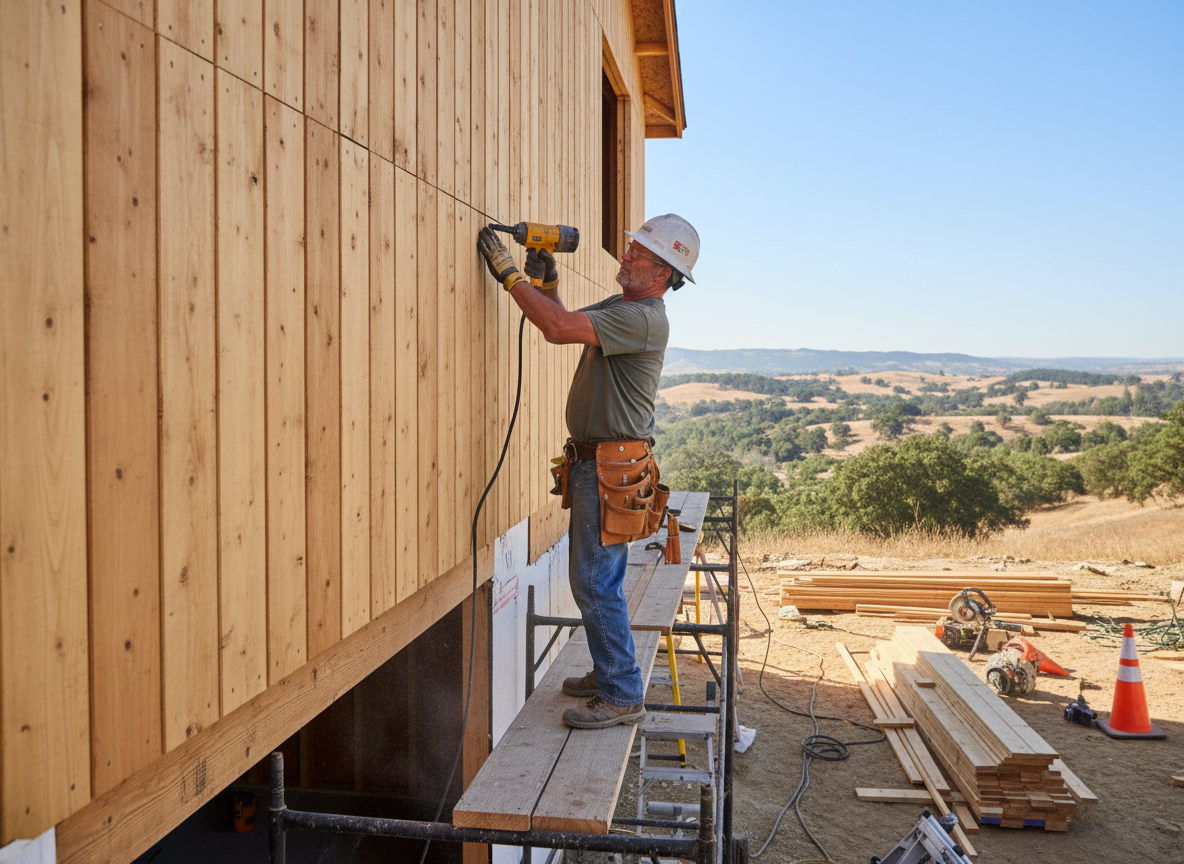
T1-11 siding, a grooved plywood panel common on mid-century homes in Oakley, demands precise installation to prevent water intrusion along the vertical channels. Cincinnati’s freeze-thaw cycles and summer humidity push moisture behind the panels when edges and grooves are not sealed with exterior-grade caulk rated for 20-plus years. Homeowners in Oakley often see rot starting at the bottom courses where splash-back from driveways and sidewalks meets the siding, especially on lots with minimal grading.
Replacing damaged T1-11 requires matching the original 4-by-8 or 4-by-9 sheet thickness and groove spacing to maintain the look of 1960s and 1970s ranch and split-level houses that dominate the neighborhood. Fasteners must be ring-shank nails or screws placed every 6 inches on edges and 12 inches in the field; skipping this pattern lets panels bow during high winds that sweep across the Oakley hills. Local building practices also call for a minimum 3/8-inch gap at the foundation and proper housewrap overlap to meet current energy codes.
Edge cases include homes where previous owners painted over the factory stain without priming the grooves, trapping moisture that migrates into the sheathing. In these situations we remove the paint film, sand the grooves, and apply a penetrating oil-based stain before new panels go up. Terrain around Oakley’s sloped streets means some properties need additional flashing at the uphill side to divert runoff that would otherwise pool against the siding.
Seasonal Maintenance for T1-11
Inspect grooves each spring after winter freeze-thaw cycles and re-caulk any separations before summer humidity sets in. Clean mildew from shaded north walls with a mild bleach solution and rinse thoroughly to avoid damaging the wood fibers.
Technician insight
In Oakley, the thing that catches most people out with t 111 siding is water trapped in the grooves on north-facing walls of 1960s ranches where the original stain has worn thin and Cincinnati winter freeze-thaw cycles push moisture behind the panel into the sheathing.
T1-11 Panel Replacement on Hyde Park Border
Problem: water stains and soft spots appearing along the bottom two courses of T1-11 on a 1968 Oakley ranch. What we found: failed caulk in the grooves plus poor drainage from a driveway that slopes toward the house. What we did: cut out four damaged sheets, replaced sheathing, added new flashing, and reinstalled matching T1-11 with fresh sealant. Outcome: siding now sheds water and matches the rest of the home’s original appearance.
How it works
- 1
Site Assessment
Walk the full perimeter of the Oakley property, note rot locations, measure panel thickness, and check grading and drainage.
- 2
Material Matching
Source T1-11 sheets that match existing groove spacing and thickness, plus compatible flashing and sealants rated for Cincinnati weather.
- 3
Panel Removal and Prep
Remove damaged sections, inspect sheathing, replace any compromised housewrap, and apply flashing at all horizontal joints.
- 4
Installation and Finish
Install new panels with correct nailing schedule, seal all grooves and edges, then apply stain or paint system chosen for the home’s exposure.
Pricing
Upfront quotes after on-site inspection; price driven by square footage, extent of rot, and accessibility on sloped Oakley lots.